Running a business becomes more challenging as it grows.
At the beginning, you may be able to manage everything with spreadsheets, notebooks, WhatsApp messages, and a few separate software tools. But as your customers, employees, products, transactions, and daily operations increase, these simple tools can quickly become difficult to manage.
You may start asking questions like:
- Where did this sales number come from?
- How much stock do we have right now?
- Did the customer make the payment?
- What did we purchase last month?
- How much money is the business making?
- Which products are selling the most?
If finding these answers takes too much time, your business may be ready for an ERP system.
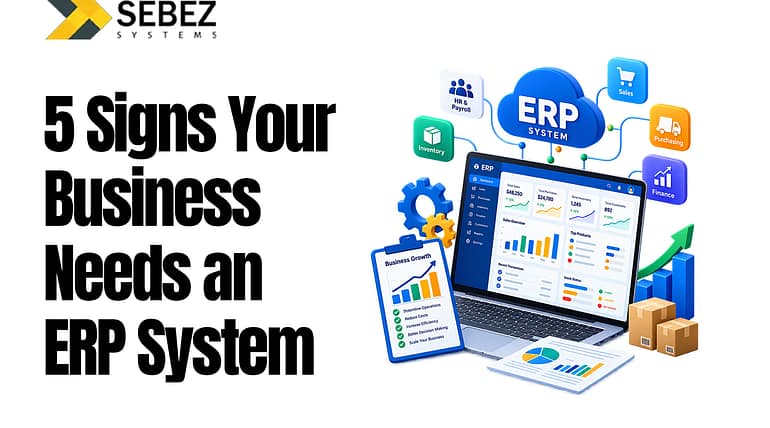
An ERP, or Enterprise Resource Planning system, connects important business operations in one centralized platform. Instead of managing different departments with disconnected tools, an ERP allows your team to work with the same information and processes.
But how do you know when you actually need one?
Here are 5 common signs that it may be time to move to an ERP system.
1. Your Business Data Is Scattered Everywhere 

One of the biggest signs is having business information spread across different places.
Your sales team may use Excel. Your accountant may have a separate file. Inventory information might be written in a notebook, while customer information is stored in WhatsApp or another application.
This makes it difficult to know which information is correct.
For example, imagine your sales team reports that 50 products are available, but the warehouse records show only 35. Which number should you trust?
An ERP system brings important business data into one place.
Sales, inventory, purchasing, finance, customers, employees, and other operations can be connected through a centralized system.
Why this matters
With your information organized in one system, your team can:
- Find information faster
- Reduce duplicate data
- Avoid unnecessary paperwork
- Keep departments connected
- Make decisions using up-to-date information
Instead of asking several people for different reports, you can access the information you need from one system.
2. Your Team Is Spending Too Much Time on Manual Work

Manual work may seem manageable when your business is small.
But as your business grows, repetitive tasks can consume a significant amount of your team’s time.
For example, employees may spend hours:
- Entering the same information into multiple files
- Preparing reports manually
- Updating stock records
- Creating invoices
- Checking customer balances
- Calculating sales
- Matching payments
- Preparing financial information
The problem isn’t just the time.
Manual processes also increase the possibility of human errors.
A small mistake in a spreadsheet can eventually affect inventory, sales reports, invoices, or financial decisions.
An ERP system can automate many of these repetitive processes.
For example, when a sale is recorded, the system can automatically update inventory and sales information. This reduces unnecessary data entry and allows employees to focus on more important work.
The goal isn’t to replace your employees.
The goal is to help your employees spend less time on repetitive tasks and more time creating value for the business.
3. Managing Your Inventory Is Becoming Difficult

Inventory can quickly become complicated as your business grows.
You may have hundreds or thousands of products, multiple suppliers, different product categories, and constantly changing stock levels.
Without a proper system, you may experience problems such as:
 Running out of popular products Ordering products you already have Losing track of stock movements Finding differences between physical and recorded stock Not knowing which products are selling slowly
These problems can directly affect your customers and your profits.
An ERP system can give you better visibility into your inventory.
You can track products, stock movements, purchases, sales, suppliers, and other inventory-related activities from one place.
Depending on the ERP solution, you can also receive alerts, generate inventory reports, monitor stock levels, and understand which products are moving quickly or slowly.
Better inventory management means better business decisions.
Instead of guessing how much stock you have, you can make decisions based on actual business data.
4. You Don’t Have a Clear Picture of Your Finances

Financial visibility is essential for every business.
But if financial information is spread across different spreadsheets, documents, bank records, and applications, it can be difficult to understand the real financial position of your business.
You may struggle to answer simple questions such as:
How much did we sell this month?
How much do customers owe us?
How much do we owe suppliers?
What are our biggest expenses?
Are we actually making a profit?
An ERP system can connect financial activities with other areas of your business.
Sales, purchases, expenses, invoices, customer accounts, supplier balances, and other financial information can be managed within an integrated system.
This gives business owners and managers a clearer picture of what’s happening financially.
Better financial visibility helps you:
- Track income and expenses
- Monitor customer payments
- Manage supplier balances
- Understand business performance
- Prepare financial reports
- Make more informed decisions
You don’t have to wait until the end of the month to discover what happened in your business.
5. Making Business Decisions Takes Too Long

Good business decisions depend on good information.
If your manager needs to ask several employees for information before making a decision, your business may be losing valuable time.
For example, suppose you want to know whether you should increase the stock of a particular product.
You may need to check sales records, inventory records, purchasing information, and customer demand separately.
With an ERP system, these types of information can be connected.
You can use dashboards and reports to quickly see important business information and identify trends.
Instead of relying on assumptions, you can make decisions based on data.
From guessing to knowing.
That’s one of the biggest benefits of having an integrated business management system.
What Is an ERP System?
ERP stands for Enterprise Resource Planning.
In simple terms, an ERP system is software that helps businesses manage different parts of their operations from one connected platform.
Depending on the business and the ERP solution, it can include modules such as:
- Sales Management
- Inventory Management
- Financial Management
- Invoicing
- Purchasing
- Customer Management
- Human Resources
- Reporting & Analytics
- Production Management
- Supply Chain Management
 Invoicing
 Purchasing
 Customer Management
 Human Resources
 Reporting & Analytics
 Production Management
 Supply Chain Management
The biggest advantage is that these areas don’t have to operate as completely separate systems.
Information can flow between different parts of the business.
Why Businesses Choose ERP Systems
An ERP system isn’t only for large corporations.
Growing businesses can also benefit from having better systems in place.
A well-designed ERP can help your business:
Save Time
Automate repetitive tasks and reduce unnecessary manual work.
Reduce Errors
Minimize mistakes caused by duplicate data entry and disconnected spreadsheets.
Improve Visibility
See what’s happening across different areas of your business.
Increase Productivity
Give employees the tools they need to work more efficiently.
Improve Customer Service
Access customer and order information more quickly.
Support Business Growth
Build systems that can handle increasing customers, products, transactions, and employees.
Make Better Decisions
Use real-time or up-to-date business information to make smarter decisions.
Do You Really Need an ERP System?
Not every business needs an ERP system immediately.
If your business is very small and your operations are simple, basic tools may be enough for now.
But if your business is growing and you’re experiencing several of the problems mentioned above, it may be time to consider an ERP.
A good starting point is to ask yourself:
Is our current system helping us grow, or is it slowing us down?
If your employees are spending more time managing information than actually using it, that’s a strong signal that your business needs better systems.
Choosing the Right ERP for Your Business
Choosing an ERP shouldn’t be about finding the system with the longest list of features.
The right ERP should solve your specific business problems.
Before choosing a system, consider:
1. Your Business Needs
What problems are you trying to solve?
2. Ease of Use
Can your employees learn and use the system easily?
3. Scalability
Can the system grow as your business grows?
4. Customization
Can it adapt to your business processes?
5. Integration
Can it work with the other tools and services your business uses?
6. Reporting
Does it provide useful reports and dashboards for decision-making?
7. Support
Will you have reliable technical support when you need it?
A good ERP should fit your business—not force your business to completely change the way it operates.
Final Thoughts
Business growth is exciting, but it also brings new challenges.
The spreadsheets that worked when you had a small team may not work when you have hundreds of customers, thousands of products, and multiple departments.
If your data is scattered, your team is doing too much manual work, inventory is difficult to manage, financial information isn’t clear, and decisions are taking too long, it may be time to consider an ERP system.
The goal of ERP isn’t simply to add another piece of software to your business.
It’s about creating a better way to manage your business.
With the right system, you can bring your operations together, reduce unnecessary work, improve visibility, and give your team the information they need to move forward.
Your business is growing. Your systems should grow with it. 
Ready to Improve the Way You Manage Your Business?
At Sebez Systems, we help businesses use technology to simplify operations, improve efficiency, and support sustainable growth.
Whether you need ERP, inventory management, sales management, POS, invoicing, eCommerce, or custom business software, the right technology can make a real difference.
 Looking to improve your business operations? Let’s build a solution that works for your business.
#ERP #ERPSystem #BusinessManagement #BusinessGrowth #DigitalTransformation #InventoryManagement #BusinessSoftware #SebezSystems #TechEthiopia